
Ritual Objects (Faqi): Tools of Focus and Ceremony
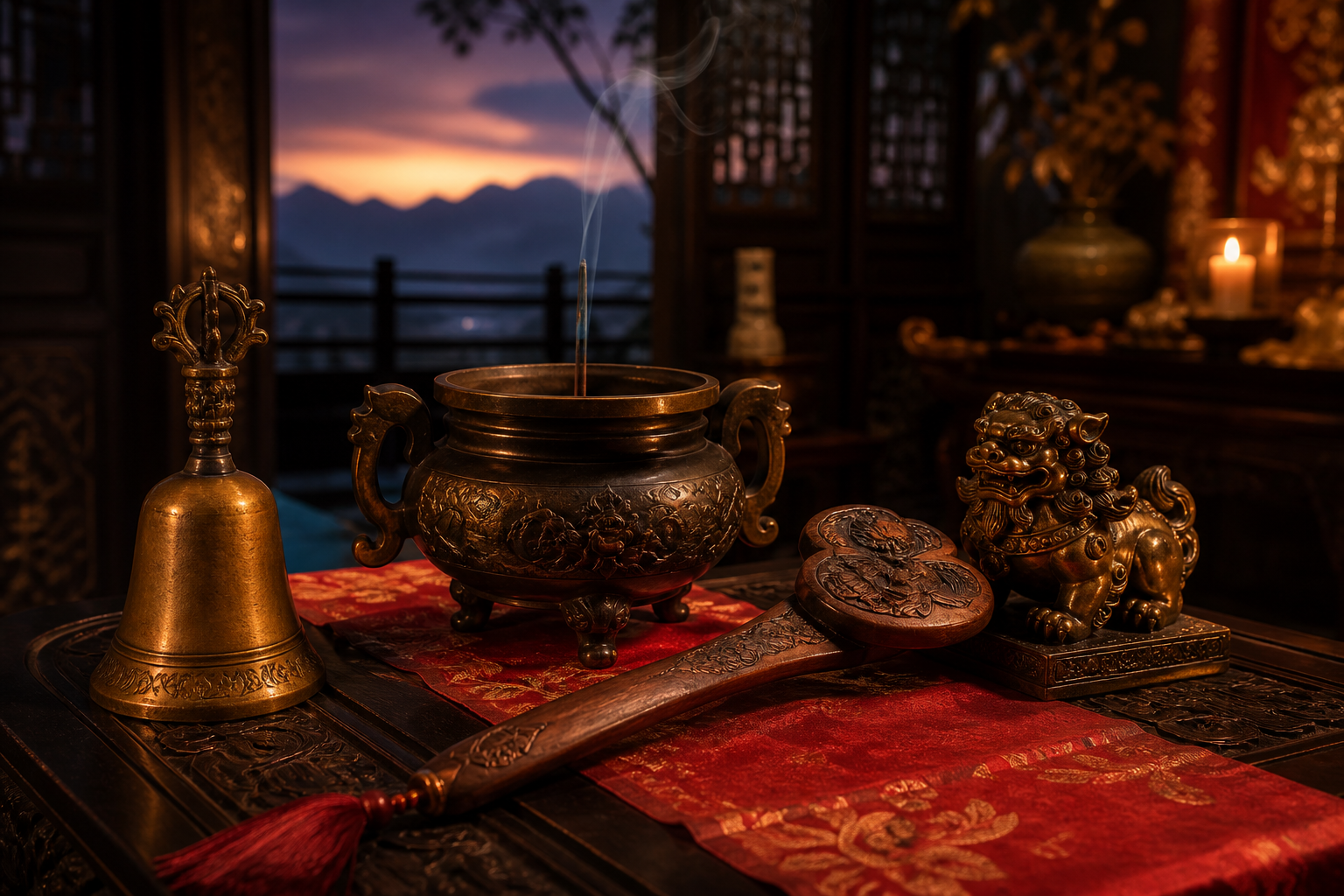
Across Taoist and Buddhist practice in China, certain crafted objects — collectively faqi (法器), "instruments of the method" — accompany ceremony, study, and daily cultivation. Beyond their beauty, each has a role.
A family of instruments
- The incense burner (香爐) — the heart of the altar; its rising thread of smoke marks a moment of stillness and attention.
- The bell (鈴) and wooden fish (木魚) — sound that gathers the mind and keeps the rhythm of chanting.
- The ruyi (如意) — a curved sceptre whose name means "as you wish," a symbol of good fortune and authority.
- The gourd (葫蘆) — associated with health and the storing of good energy.
- Guardian figures such as the pixiu — protective motifs placed with respect.
Why crafted objects help
Ritual objects work first on attention. Lighting incense, sounding a bell, arranging an altar — these small, deliberate acts move us out of hurry and into presence. In this sense a faqi is a tool for the mind: it makes an intention physical and repeatable.
Living with faqi respectfully
- Keep them clean and in a settled, uncluttered place.
- Handle them with care, as you would any meaningful heirloom.
- Let their use be a small daily ritual rather than mere decoration.
The instrument is silent until a sincere hand takes it up.
We present faqi as cultural craft and as companions to a mindful life. Their traditional meanings are shared for appreciation and context, not as promises of particular outcomes.
A note on spirit and honesty: at HE FAJIE we share these traditions as living culture and art. Everything here is offered for cultural understanding and personal reflection — never as a promise of specific real-world, medical, or financial outcomes.