
The I Ching Explained: Reading the Book of Changes
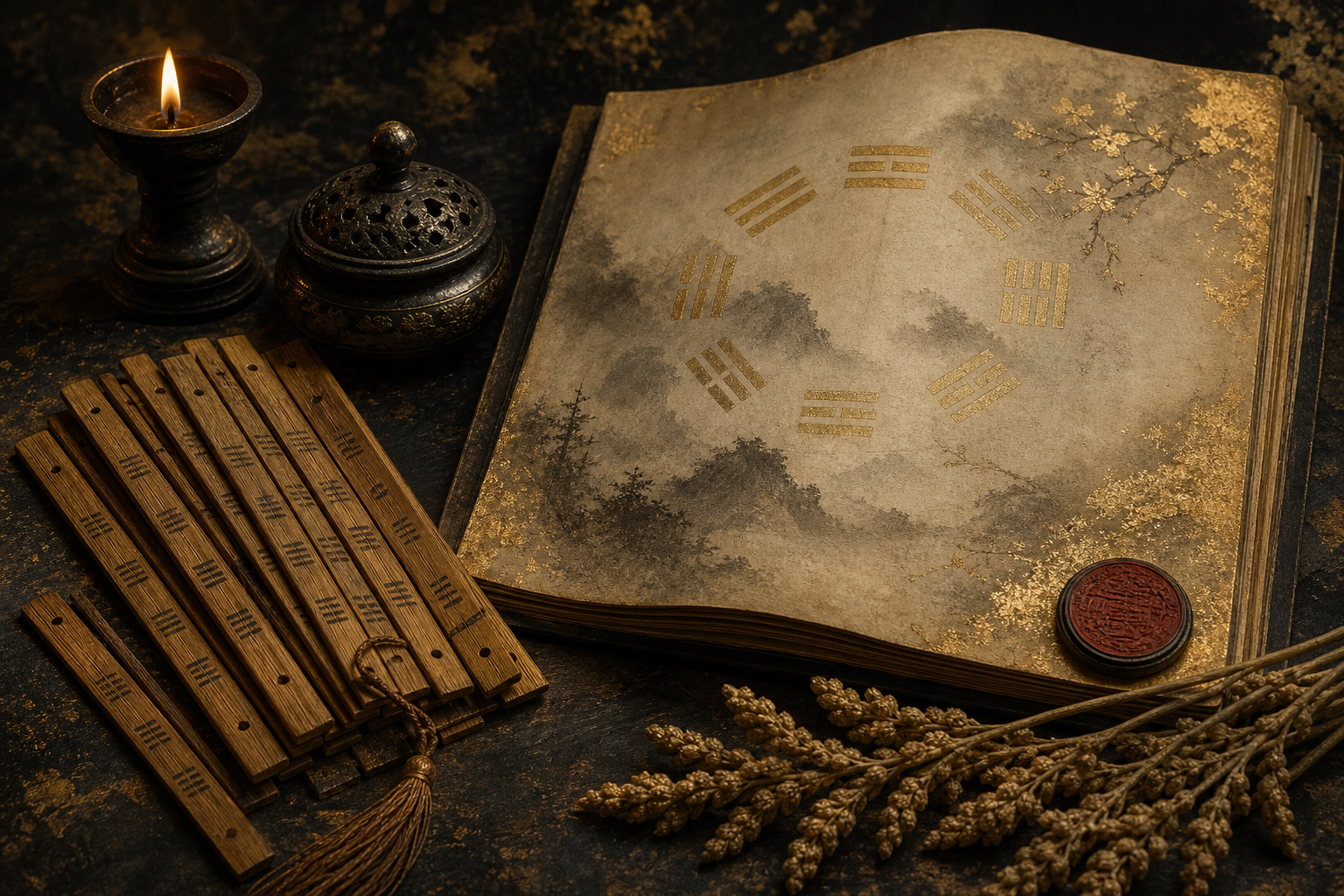
The I Ching (易經, Yì Jīng), or Book of Changes, is among the oldest and most influential books in the world. For over three thousand years it has been read as a manual of wisdom, a mirror for decisions, and a map of how situations transform.
Lines, trigrams, and hexagrams
Everything in the I Ching is built from a single distinction: a solid line (yang, ⚊) and a broken line (yin, ⚋).
- Stack three lines and you have one of the eight trigrams (八卦, bāguà) — Heaven, Earth, Water, Fire, Thunder, Wind, Mountain, Lake.
- Stack two trigrams and you have one of the sixty-four hexagrams, each a portrait of a moment in the endless dance of change.
Not fortune-telling, but insight
The classical view is subtle. The I Ching does not "predict" a fixed future. It offers an image of the quality of the present moment — its pressures, its openings, its wise response — so that you can act in harmony with it. A hexagram is a question turned back toward the questioner.
Plum Blossom and the timing method
One elegant tradition, Plum Blossom Numerology (梅花易數, Méihuā Yìshù), casts a hexagram from numbers drawn from time itself — the year, month, day and hour — reading the pattern already present in the moment of asking. It analyses the relationship between the "body" and "use" trigrams through the Five Elements to weigh whether the moment favours action or patience.
Our own Daily Oracle draws on this Plum Blossom method — pairing your star sign with the present hour to offer a gentle reading for the day.
How to approach it
- Bring a real, sincere question.
- Read the hexagram as advice, not command.
- Notice the "changing lines," which show where the situation is already turning.
Approached this way, the Book of Changes becomes what its title promises: not a crystal ball, but a companion in living wisely with change.
A note on spirit and honesty: at HE FAJIE we share these traditions as living culture and art. Everything here is offered for cultural understanding and personal reflection — never as a promise of specific real-world, medical, or financial outcomes.