What Is the Tao? The Pattern Behind Heaven and Earth
The word Tao (道, dào) is usually translated as "the Way." But the Tao is less a road you walk and more the quiet pattern by which everything moves — the rhythm shared by the turning seasons, the flow of rivers, the breath in your chest.
"The Tao that can be spoken is not the eternal Tao." — Dao De Jing, opening line
The Way that cannot be named
Laozi begins the Dao De Jing with a paradox: the moment we name the Tao, we have already limited it. The Tao is not a god or a rule-book. It is the source and the pattern at once — present in the largest galaxy and the smallest seed, yet never grasping, never forcing.
Reading the laws of Heaven and Earth
Chinese thought does not separate humanity from nature. To "capture the laws of Heaven and Earth" (天地規律) is simply to observe carefully and align with what is already true:
- Day gives way to night; effort gives way to rest.
- What rises must fall; what is full begins to empty.
- Soft water, given time, wears down hard stone.
The sage does not fight these currents. This is wu wei (無為) — often mistranslated as "doing nothing." It really means effortless action: acting so precisely in tune with the moment that struggle disappears, the way a skilled sailor uses the wind rather than rowing against it.
Yin, yang, and the Taiji
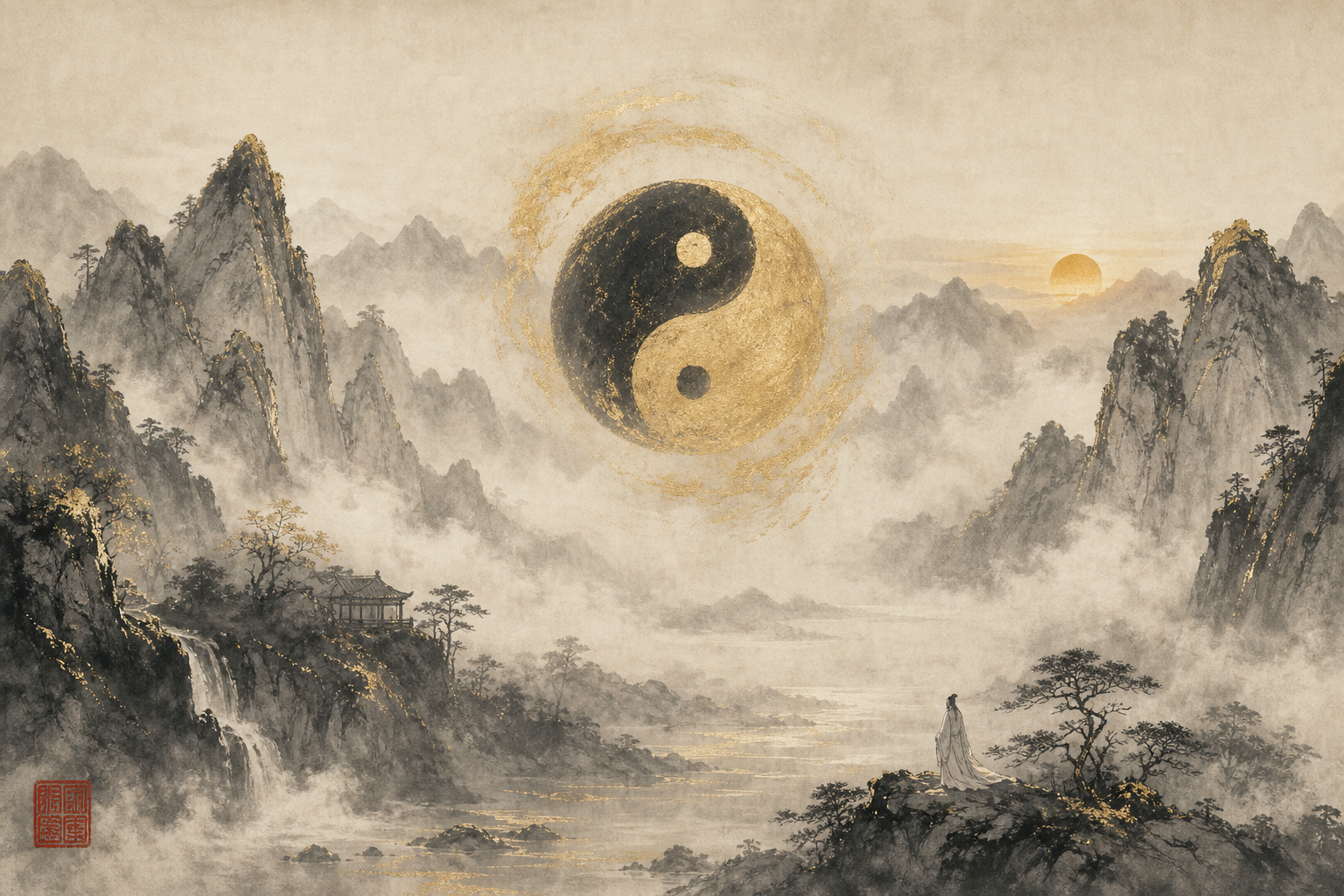
Within the Tao, all things arise from the play of two forces — yin (receptive, cool, still) and yang (active, warm, moving). Neither is good or bad; each contains the seed of the other, and together they turn like the two fishes of the Taiji symbol. Health, art, and a good life all come from balance between them.
Living the Tao today
You do not need a mountain temple to practise the Way. It shows up in ordinary attention:
- Move with the season rather than against it.
- Do less, but do it with full presence.
- Let simplicity, patience, and kindness guide your choices.
This is the ground beneath everything else in Chinese metaphysics — the I Ching, the Five Elements, feng shui, and the arts of the brush. Understand the Tao, and the rest becomes a family of ideas rather than a list of superstitions.
A note on spirit and honesty: at HE FAJIE we share these traditions as living culture and art. Everything here is offered for cultural understanding and personal reflection — never as a promise of specific real-world, medical, or financial outcomes.